
I was interested to read about the removal of the 100 hour contract exemption this week, and I'm sure it will be much welcomed by many worried contractors...This exemption was brought in a few years ago and led to a massive number of these contract applications...Perhaps some have been warranted in certain circumstances; but the vast majority have been seen as unjustified by many leading to problems for existing contractors. Certainly the LPC has spent a considerable sum of contractor's money addressing these applications - and has been worried about the destabilising effect large numbers of new contracts have on the existing contractor network. The removal of the exemption was achieved through amendments to the regulations, such that, new market entrants will be judged on a new market entry test based on the pharmaceutical needs assessment (PNA). The LPC is looking forward to working with the PCT via the PNA to plan pharmacy openings, and new services, where they will bring real benefit to patients...
0 Comments
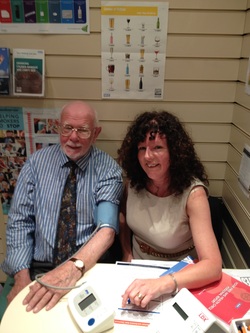
On July 17th, we were fortunate to have a visit to our pharmacy by Councillor Allan West. Councillor West is a member of the Health & Wellbeing Board in South Tyneside; and attended the pharmacy to see, and talk about, NHS Healthchecks - offered from Community Pharmacy. As Chairman of the LPC, I used the opportunity to discuss the extended role that community pharmacy can make in public health, particularly through the Healthy Living Pharmacy Initiative. We discussed EHC, Methadone Services, Minor Ailment Schemes, Smoking Cessation Services etc. He was most impressed with the idea of accessing public health services from Community Pharmacy and agreed to meet up with members of the LPC to explore ideas at a later date. The photograph, below, shows Julie Carter discussing NHS Healthchecks with Councillor West in the pharmacy consulting room. More young people than ever before are taking a degree in pharmacy... There are more schools of pharmacy than ever before, and more students in them. New university courses seem to be popping up everywhere. A recent report by the Modernising Pharmacy Careers Programme stated that the number of pharmacy schools in England increased from 12 to 29 between 1999 and 2009, and the number of pharmacy students went up from 4,200 to 9,800. The problem with this situation is that some students are finding it very difficult to obtain pre-registration places; and pharmacist jobs are becoming more hard to find. Surely this situation needs to be addressed? With over demand, the knock on effects to terms of service and moral within the profession will be catastrophic. There is simply no point in producing loads of expensive pharmacists with nowhere to go...except out of the profession? Thankfully, pharmacy organisations are talking about this and hopefully a solution will evolve...perhaps in the form of more roles for pharmacists - let's hope so - for the sake of young pharmacists... A recent article in the Telegraph highlighted the fact that over 54 million GP appointments were for minor illnesses - in fact they went further to say that 1 in 5 GP appointments could be avoided if patients accessed self care or accessed advice from pharmacists. These "saved appointments" could be used for patients with more serious conditions and improve access for all! http://www.telegraph.co.uk/health/healthnews/9392184/Millions-see-GP-for-stuffy-noses-and-dandruff-in-waste-of-appointments-survey.html This is really good news for community pharmacy, as the current network of community pharmacies is ideally placed to provide good value professional advice and support for minor ailments; and this article provides exceptionally good evidence for minor ailment schemes from community pharmacy! As a contractor, offering pre-registration training can be one of the most professionally rewarding things that a pharmacist can do; but it can be time consuming and labour intensive - and there are some competencies that are simply too difficult to offer easily and that are essential for adequate training and preparedness for the pre-registration exam. As a consequence pharmacist tutors have to seek out these training needs via a 3rd party agency - often at a distance. I am delighted, therefore, to see that our local university - Sunderland University - is now offering an exciting new training program to satisfy these learning objectives. The course is delivered over 10 weeks (one day per week), and, in addition to satisfying the theory required for the examination, gives the pre-registration pharmacist the opportunity to network with other graduates - and experience a trial examination in the actual place were the exam is done - surely a good thing to help with exam nerves! I think I drink quite a lot of coffee a day...probably 4 cups during the day (mostly cold!) when I'm at the shop, plus others. Many pharmacists drink considerably more than this...and some people I know drink it all the time - especially when working long hours. It started me thinking about the health benefits and risks of coffee... Coffee is one of the most popular liquids in the world - which makes caffeine (a major component) one of the most widely consumed pharmacologically active compounds on the planet - as it is the major "active" molecule in coffee. Interestingly, however, coffee contains many thousands of other compounds, and so the effects of coffee on the body are not entirely due to the caffeine. Also, caffeine is found in tea, cola and cocoa not just coffee! The most common coffee varieties, Arabica and Robusta, contain about 100mg and 200mg respectively per average 150ml cup. Tea, cola and cocoa contain a lot less caffeine, approximately 37mg, 25mg and 4mg for a similar volume respectively. Most people drink coffee because they like it, although some do so because caffeine stimulates the central nervous system, alleviating fatigue, increasing wakefulness, and improving concentration and focus. The rate of elimination of caffeine varies between individuals, but the half life is generally between 5 and 7 hours - and this can vary between individuals by a factor of up to 4 - and also seems to be dose dependent - so it's best avoided in the evening. So no coffee after 6pm!
6-30pm totally unaware of the problems - London had blue sky and was hot and sticky (28'C).
When I flew back to Newcastle - There was Chaos! It took me until 11pm to drive back from the airport... Our shop has suffered a little damage as water came through the shutter mechanism...but nothing compared to some pharmacies. One pharmacy in particular had a metre of water flooding the shop. I take my hat off to the staff in that pharmacy who continued to provide pharmaceutical services the next day as they cleared up the storm damage. Another refit will be needed, but their stoic spirit is a credit to the profession and themselves! Well done to all who experienced difficulties, kept calm and carried on regardless. The way Community Pharmacy is funded is going to change over the coming years. We have been told by Sue Sharpe, the Chief Executive at the PSNC, that the changes will be evolutionary and not revolutionary - so hopefully we'll still be left with some of the baby in the bathwater when everything changes. Personally I'm in favour of this cautious approach...I don't want to give funding away without guaranteed adequate funding coming back in a different form. Other pharmacists, however, have stated that we must have accelerated change to a completely new contract - to ensure we get our fair share whilst uncertainty exists...Perhaps the answer lies in the mid-ground - a relatively quick introduction of a new contract that rewards clinical outcomes, whilst preserving the "core" of our business? One thing is certain, we simply cannot continue to do more and more for the same amount of remuneration...As costs go up, so should our profits. Pharmacy is a business and we need money to survive - like any other business. Any new services should come with new money to fund them - as new services require investment! If we continue to be squeezed this isn't helpful to anybody...more stress leads to more risk... |
David CarterChairman of Gateshead & South Tyneside LPC gives you his thoughts of the day Archives
July 2015
Categories
All
|